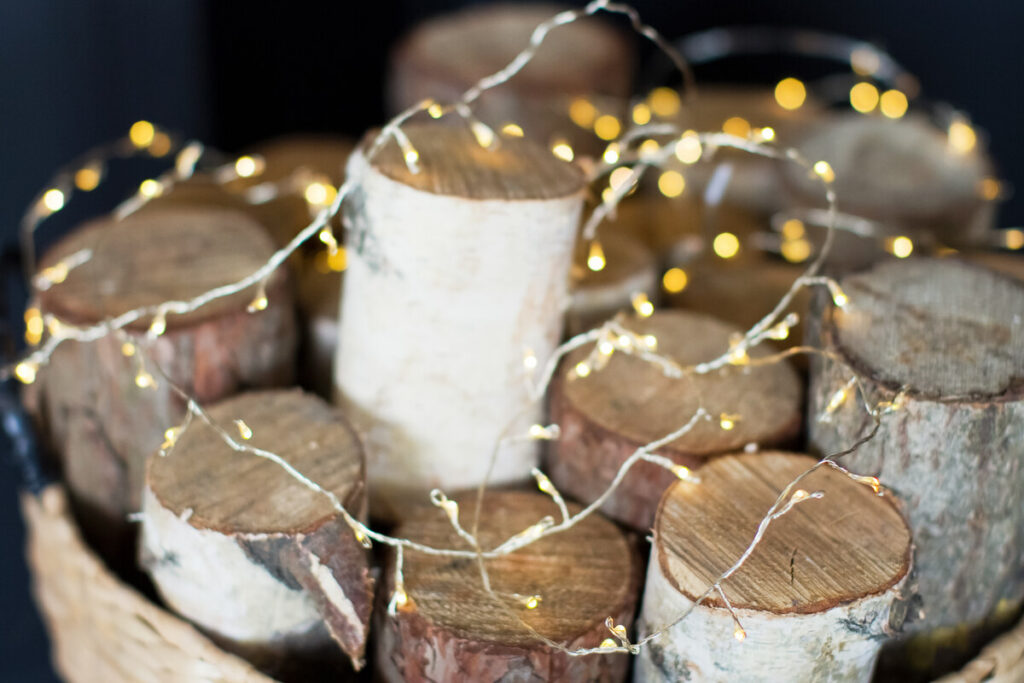
That big planter sitting empty by the door since late summer deserves better than a winter in the garage. Fill it with three birch poles of different heights, wrap them in warm white lights, and your entry looks finished from the first Sunday of Advent well into February.
No tree to drag out, no needles to vacuum up, and nothing that looks sad on January 2nd. Once the holiday greenery comes off, the same display simply changes outfits and keeps going until spring.
What you need
- 3 birch poles, about 2.5 to 3 inches thick
- 1 heavy planter, at least 16 inches across, with a drainage hole
- Coarse sand and gravel
- A warm white micro LED string made for outdoor use, ideally on a timer and with a dark wire
- A few evergreen branches and some big pine cones
Look for birch poles at garden centers, craft stores, florists and online shops that sell decorative wood, especially during the holiday season. Check the bark before you buy. It should be dry, intact and bright white, because a stained pole or one with peeling bark looks tired on day one. And skip the idea of cutting your own from the nearest patch of woods unless the land is yours.
Cut the poles at three different heights
Trim the poles to roughly 32, 40 and 48 inches. Three identical lengths look like a leftover piece of fence, while that eight-inch step between them reads as a little grove. Mark each cut square and saw the base straight. A crooked bottom means a pole that wobbles in the planter no matter what you do.
Skip the potting soil and use sand and gravel
It is tempting to grab the half bag of potting mix in the shed, but it packs down within weeks and holds water, so the base of the poles sits wet and the bark starts to blotch. Concrete goes the other way: rock solid, but it ruins the planter and turns it into a block you can never move.
For a seasonal display, a sand and gravel mix wins. It grips the poles right away, lets rain drain out, and empties completely in spring.
- Start with a hand’s width of coarse gravel at the bottom for drainage.
- Add the sand and gravel mix until the planter is about two thirds full.
- Stand the poles slightly off-center from each other, not in a straight line.
- Fill in layer by layer, pressing each layer down with your fingers until no pole moves.
That drainage hole matters more than it seems. Water trapped in a closed container freezes and can crack terracotta or ceramic. If your favorite planter has no hole, drill one if it is plastic or fiber cement, or tuck a fragile ceramic one under a porch roof. A heavy, frost-resistant planter is the best choice, since lightweight plastic ones tip over in the first strong gust.
After the first big rain, check it again. The fill settles and the wood shrinks a little as it dries, so top it off, press it down one last time and give each pole a shake. It takes a minute and keeps the whole thing from ending up across your doormat after the next storm.
Wrap the lights loosely
Outdoor lights are the one place not to improvise. The string, its power adapter and the connections all need to be rated for outdoor use, so check the packaging. An indoor string plugged into an outdoor outlet is the classic mistake, and it is often the little power box, not the lights, that was only built for dry conditions. Cold does not bother LEDs. Battery models, on the other hand, get expensive fast if you want them running for weeks.
Wind the string in a wide, loose spiral from bottom to top. Tight wraps squash the look: the white bark should be the star and the light just the frame. A warm white string with a dark wire on a timer, say 5 p.m. to 10 p.m., is perfect. By day the wire disappears into the bark, and at night the trio welcomes everyone at the door on its own.
If your planter is not under cover, raise the plug connection up between the poles or slip it into a waterproof cord box. Lying flat on the ground, it will collect every puddle.
Dress the base, then change it in January
Push evergreen branches into the sand, packing them tight until nothing shows through, then tuck a few big pine cones in between. For the holidays, two or three matte ornaments and a linen ribbon are plenty.
When the holidays are over, everything stays in place and only the base changes. Pull out the evergreens, set cushions of moss over the sand, and add a pot of snowdrops or hellebores next to it. Now it reads as winter decor instead of leftover Christmas, and it carries you until the first spring blooms take over.