Your mail carrier knows exactly where you live. The pizza driver at 8 p.m., a substitute delivery driver or an ambulance crew do not. All they have to go on is the numbers on your house, and if those are tiny, faded or hidden behind a climbing rose, everyone loses precious minutes.
Swapping out house numbers is a cheap, satisfying weekend project, and if you get a few basics right, you only have to do it once. Many towns and fire departments set their own size or placement rules, so check yours before ordering.
Start with what can be read from the street
Your numbers get read from the road, by someone rolling slowly past, very often after dark. As a rule of thumb, digits 3 to 4 inches tall stay readable from about 65 feet away, while anything under 2 inches is only visible from the sidewalk. If your house sits far back or behind a gate, go up to 5 or 6 inches and put the numbers near the street, on a post, a gate pillar or the mailbox, rather than on the front door.
- Contrast first. Dark on light or light on dark, never tone on tone. Gold digits on honey-colored wood look lovely up close and vanish at thirty feet.
- Keep the font simple. Script and old-fashioned numerals (a 1 that looks like a 7, a closed-top 4) are hard to read in passing. A bold sans-serif is the safe bet, even on a traditional house.
- Give them clear space. Mount them 4 to 6 feet off the ground, never behind shrubs or vines. If your entry is dark, add a small light or pick a reflective finish.
Pick a material that suits your house and your weather
- Engraved brass: warm, classic and good for decades. It darkens into a soft patina; leave it, or polish once a year with a brass cleaner and a thin coat of clear wax. Great on stone, brick and light stucco.
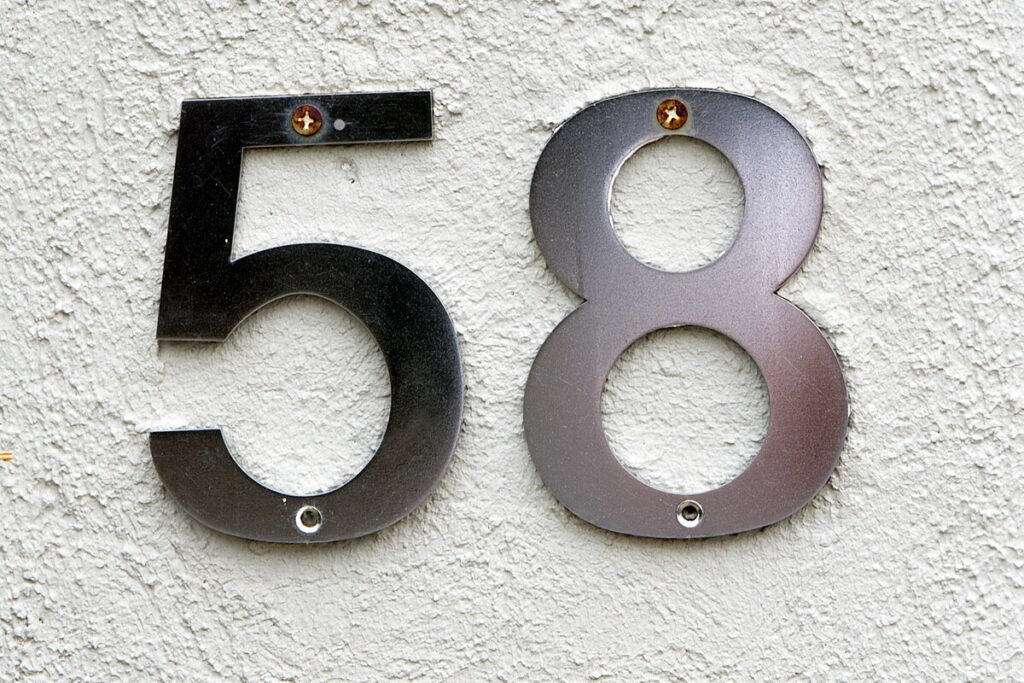
- Aluminum: crisp and modern, usually matte black or gray. It will not rust and only needs soapy water. Perfect on modern siding.
- Acrylic: bright colors or a glassy look, with the print protected under the surface. It handles sun well but scratches easily, so use plain water and a microfiber cloth, never solvents.
- Wood: cozy, with carved numbers, but it needs oil or exterior stain every year or two.
- PVC: light, cheap and colorful, but it can fade in full sun.
Exposure matters as much as material. A plaque in full sun with no overhang ages about twice as fast as one under a porch roof, so brass or aluminum is the smart pick there.
Screws, spacers or adhesive
- Visible screws are the sturdiest choice on brick, stone and stucco. Brass or stainless caps turn them into a nice detail.
- Standoff spacers hold the plaque half an inch to an inch off the wall so it seems to float.
- Heavy-duty double-sided tape works on smooth, clean surfaces like a metal gate, glass or tile. Skip it on textured stucco or peeling paint.
- Rails or clips make sense if you may swap the sign later.
Match the mailbox and keep the look tidy
If your mailbox sits by the curb, put your numbers on it too, on both sides if you can, so drivers coming either way spot them. A family name on the box cuts down on misdelivered mail; use an engraved or weatherproof plate, not a handwritten label that washes away in the first rain.
Using the same material and font for the numbers, mailbox and any name sign is what makes an entry look finished. When you decorate for the seasons, hang the wreath on the door and the lights on the railing, and leave the numbers uncovered. They are the one thing out front that needs to be visible all year.
A little upkeep so they last
- Twice a year, wipe any plaque with warm soapy water and a soft cloth, no scrubbing sponges.
- Reoil wood every 12 to 24 months and touch up faded carved digits.
- After winter, check the screws or tape. A sign that wiggles in the wind ends up in the flower bed.
- Keep about a foot of clear space around the numbers when you trim hedges and vines.
Smart tricks before you buy
Around here, I am all for anything that saves a second trip to the hardware store, and this does exactly that: cut a cardboard template the size you are planning, tape it up and look at it from the street one evening. You will know right away if it works. On an open gate, mount the numbers on the post so they do not swing away every time it opens. And for a dark entry, a light plaque with black digits under a small solar spotlight costs far less than a lit sign and reads just as well.