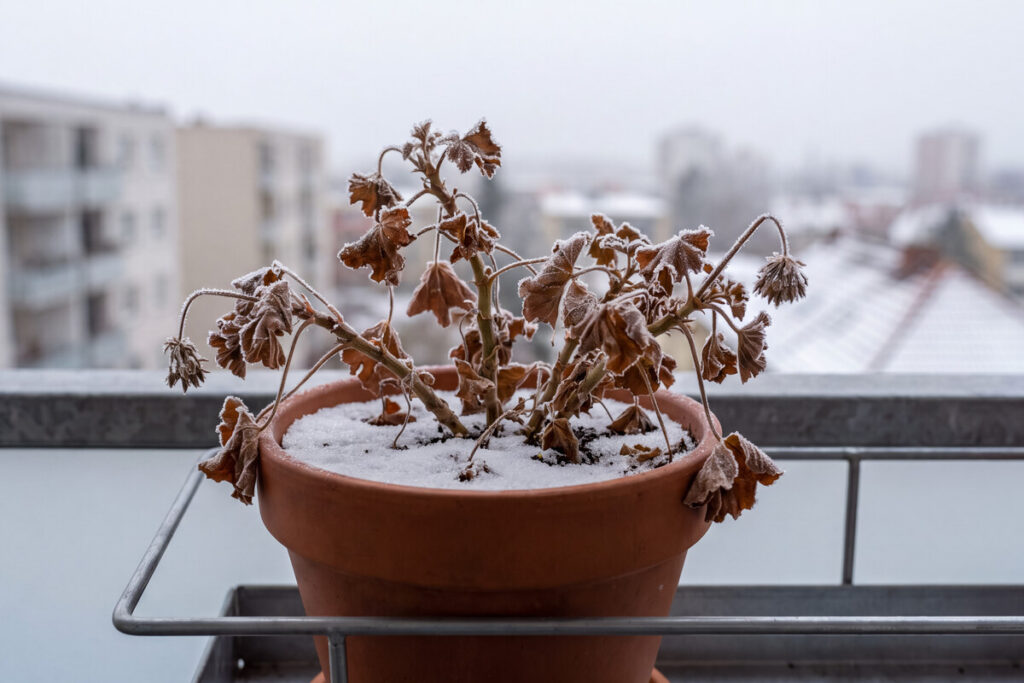
A potted rose still drinks in winter, just far less often: about once every two to three weeks, in the morning, on a day when the soil is not frozen. The calendar only tells you when to check. Your finger in the soil decides whether the watering can comes out.
Why a bare rose still needs water
The leaves are gone and the plant looks asleep, yet the root ball keeps losing moisture. The canes transpire a little all winter, dry wind speeds it up, and the soil surface evaporates every time the sun warms a terracotta wall. A rose planted in the ground can send roots deeper to find water. In a pot holding 5 to 10 gallons, there is nothing underneath.
Cold air is rarely the real culprit, since many roses tolerate temperatures down to around -4°F. What kills a container rose is the state of the root ball: frozen solid, so the roots cannot absorb a drop, or bone dry under a winter wrap that works like an umbrella. A perfectly bundled rose can die of thirst in February.
Every two to three weeks, on a thaw morning
Amount matters as much as timing. Pour slowly at the base, ideally from a can without a sprinkler head. For a pot 12 to 16 inches wide, about 2 to 3 quarts is plenty, and you stop the moment water shows at the drainage holes. One generous watering beats small weekly splashes that only wet the top inch.
Before you fill the can, pull back any mulch and push your finger about an inch into the soil. Dry and crumbly means water. Still cool and damp means check again in a week. It takes ten seconds and saves you from most unnecessary watering.
The weight of the pot adds a second clue. Tilt it toward you: a saturated root ball is clearly heavier than a dry one, and that reading covers the full depth of the soil, not just the surface.
Water in the morning so the moisture soaks in before nightfall. Be careful on days forecast around 35°F. On a clear, windless night the air near the ground can run a few degrees colder than the forecast, and the soil in the pot may freeze even when the thermometer looks reassuring. Always water at the base, never over the canes, because mildew and rust spores overwinter on young stems and fallen leaves.
Which check works best
- Finger test: about 10 seconds, very reliable, but it will not show water pooling at the bottom.
- Lifting or tilting the pot: about 5 seconds, reads the whole root ball, impractical on a big wrapped planter.
- Calendar reminder: a decent prompt to check, but a poor measure on its own.
- Counting on rain: weak, because most potted roses spend the winter against a wall or under an overhang.
- Soaking the pot for 15 to 20 minutes: rescue only, for a root ball that has turned water-repellent after months of neglect. Drain it well so nothing freezes overnight.
The winning pair is the finger test plus the weight check: one reads the surface, the other reads the bottom, and neither costs anything.
Three mistakes that cost you the rose
Watering frozen soil is the harshest one. The water cannot sink in, sits on top and forms an ice crust around the base of the plant. Wait for the thaw, even if that means ten more days.
Leaving the saucer under the pot comes next. Water collects there, freezes, blocks drainage and can crack a terracotta pot. From November through February, remove the saucer and lift the pot on two wooden blocks or a piece of foam board.
The last one is forgetting the pot entirely once it is wrapped. Burlap or fleece keeps rain off the soil, so lift an edge every couple of weeks and do the finger test anyway.