A little evergreen in a nursery pot can easily top three feet in fifteen years, and nothing on the plant tag will warn you. If you want a conifer that stays put on a porch, patio or small front bed, you have to know what “dwarf” really means.
The tag tells you the size at ten years, not the final size
Plant growers call a conifer “dwarf” based on how fast it grows, usually somewhere between 1 and 6 inches a year. The height printed on the tag is what it reaches after ten years of growing, not how big it will ever get. A dwarf conifer never stops growing. It keeps the same yearly pace, so it is roughly twice as big at twenty years and three times as big at thirty.
Many of these plants started as compact mutations, tight little clumps on an otherwise normal tree, which were then propagated to keep that dense shape. Compact does not mean frozen in time.
The classic cautionary tale is a nest spruce sold as a dwarf. Given a century, an old specimen can pass 10 feet tall and spread more than 26 feet wide. And a plant labeled only “dwarf conifer,” with no variety name, is a gamble, because there is no way to know how fast it grows.
Best choice for a sunny pot: mugo pine ‘Mops’
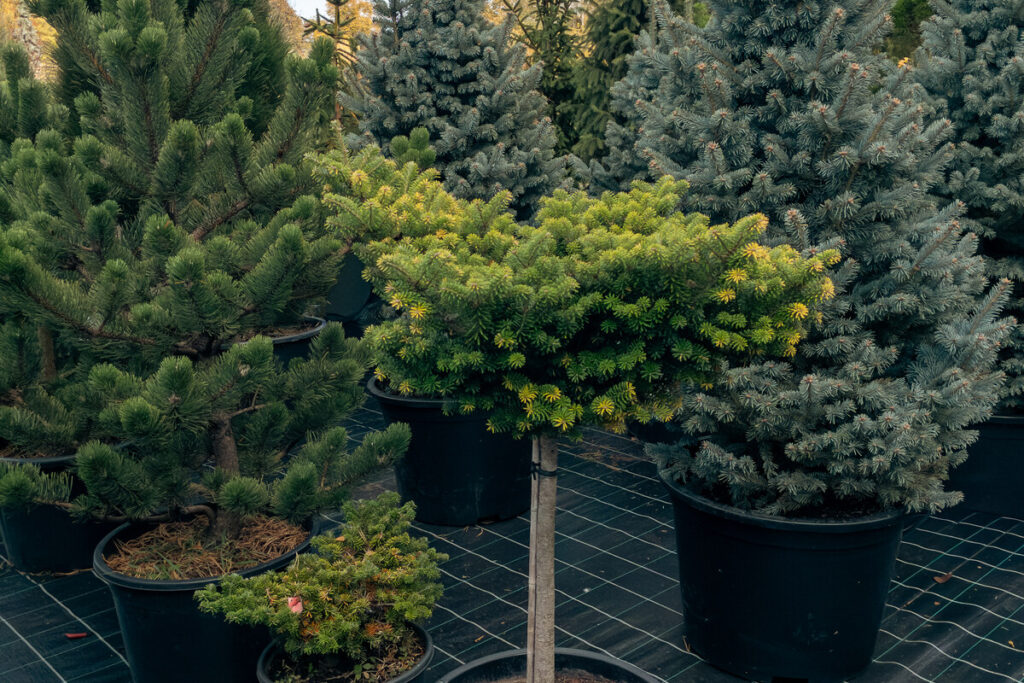
If your spot gets full sun, the dwarf mugo pine called ‘Mops’ is the one I would reach for. It forms a dense, even ball with short needles in bundles of two, and it adds only about 2 to 3 inches a year. That works out to about 28 inches tall and wide at ten years, and it would need another decade or more to pass three feet.
Pines also grow in a single flush each spring, so the growth is predictable and easy to slow down. A few tips for keeping it happy:
- Pick a wide pot, not a tall one. It spreads as much as it rises, and a narrow container gets top-heavy and tips in the wind.
- Make sure the drainage holes stay clear and add a layer of clay pebbles or gravel at the bottom. Standing water in winter hurts far more than frost.
- To keep it even smaller, trim the new “candles” in late spring, cutting back a third to two thirds of that year’s growth and never cutting into old wood.
- Go easy on fertilizer. Rich soil pushes growth and you lose the tight shape.
Fall is a fine time to plant a container conifer as long as the ground is not frozen. In colder regions, waiting for a mild spell or early spring is the safer move.
For shade, a dwarf yew works, with one big warning
A north-facing porch or enclosed courtyard is rough on mugo pine, which thins out without direct sun. A dwarf yew such as ‘Fips’ is the better fit there. It makes a low, compact cushion, grows only a few inches a year and keeps its evergreen foliage, even sprouting back from old wood, so you can hold it to the size you want for decades.
Now the serious part: yew is toxic. Needles, seeds and bark can all make people and pets sick if eaten, and the only safe bit is the soft red fruit flesh around the seed. Small children are drawn to those sweet-looking red berries. If a toddler or a dog spends time on your patio, skip yew, and collect trimmings carefully. If anyone swallows some, call poison control right away, even if there are no symptoms yet.
Other options and how they compare
- Dwarf globe arborvitae (varieties like ‘Tiny Tim’ or ‘Danica’): about 1 inch a year and roughly 10 inches tall at ten years, so the slowest of the bunch. It handles sun to part shade, but the foliage browns if the root ball dries out. It can look a bit like a nursery ball.
- Nest spruce: looks charming when young, but it never stops spreading. It is not a good long-term pot plant.
- Anything sold only as “dwarf”: the least reliable choice of all.
Quick checks before you buy
- At the garden center, ask for the yearly growth in inches, not the height of the plant. Under 4 inches a year stays manageable for decades.
- Look for the exact variety name on the tag, not just “dwarf.”
- In winter, set the pot up on feet and tuck it against a sheltered wall. In a container, it is the roots that suffer, not the foliage.
- Write the purchase date on the tag so you know where you are in the ten year count.
One last rule of thumb: measure the plant in its pot, then add about 2 to 3 inches for every year you plan to keep it on the porch. If the total is bigger than the space you have, put it back on the shelf.