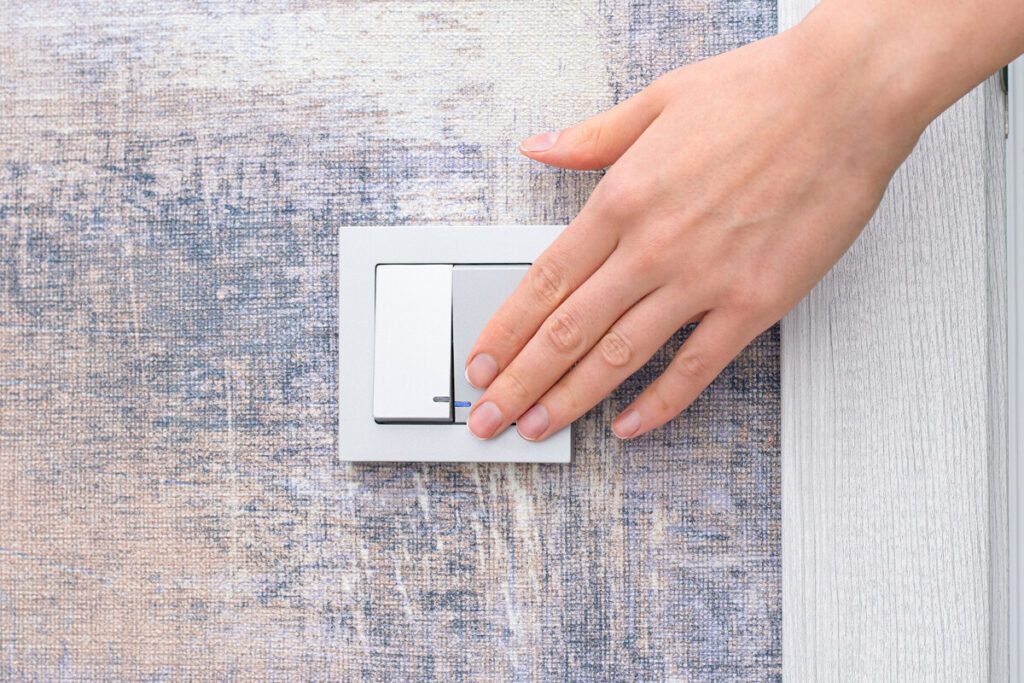
“Turn off the light!” is probably the most repeated sentence in my house, right after “where are your shoes?” It turns out the habit is mostly right, but not always for the reason we think, and the smartest rule depends on what kind of bulb is sitting in the fixture.
Most of us grew up with the switch-it-off reflex drilled in alongside turning off the faucet and finishing your plate. It feels like plain common sense. But energy pros have a more nuanced take: flipping lights off every single time does not always save as much as we imagine, and with certain bulbs, constant on and off cycles mostly just wear them out faster. So the habit stays, it just gets a little smarter.
The myth about turning lights back on
You have probably heard that switching a light back on uses more power than leaving it on for a few minutes, because of some big surge at startup. That one can go. Any extra draw when a bulb turns on lasts a fraction of a second and barely registers on a utility bill.
The real question is not the electricity, it is the lifespan of the bulb. Some types handle being switched on and off all day without blinking. Others do not, and that is where the rule changes.
What is actually in your light fixtures
Here is a quick rundown of the four bulb types still floating around most homes:
- Old-school incandescent bulbs are the least efficient by far. Only about 10% of the energy they use turns into light; the rest becomes heat. They last somewhere around 750 to 1,000 hours.
- Halogen bulbs do a bit better, but 80 to 90% of their energy still goes out as heat. Expect roughly 1,000 to 2,000 hours from one.
- Compact fluorescent bulbs (the curly CFLs) are far more efficient and last around 8,000 hours, but they really do not like being flicked on and off over and over.
- LED bulbs can use up to 90% less energy than incandescents and last about 25,000 hours. They also shrug off frequent switching.
The simple rule, bulb by bulb
Once you know what you are working with, the rule is easy to remember:
- LED: switch it off as soon as you leave, even if you will be back in a minute.
- CFL: only switch it off if the room will be empty for more than about 15 minutes.
- Halogen: switch it off every time you walk out, because it is a power hog.
- Incandescent: switch it off every time, and swap it for an LED as soon as you can. Over the life of a single bulb, that swap adds up to real money.
In practice, that means a hallway or half bath still running on CFLs is the one place where constant flicking can backfire. If every trip is a few seconds long, you wear the bulb down for almost no energy savings. In a bedroom or home office you are leaving for 15 minutes to take a call or start dinner, cutting the light still makes sense, even with those more sensitive bulbs.
Let the house do the remembering
Around here, nobody is going to remember a bulb chart at 7 a.m., so the easier move is to take the decision out of our hands. Motion sensors, occupancy switches and timers will shut lights off automatically in the spots people just pass through, like hallways, stairs, the laundry room and the garage.
Zone lighting helps too. Turning on a couple of LED lamps where you actually are, instead of a big overhead fixture that lights the whole room, trims usage without anyone feeling like they are living in the dark.
Keep lighting in perspective
Here is the part that took the guilt out of it for me: a small LED bulb costs a fraction of a cent per hour to run. Taken on its own, a forgotten light is not what blows up your energy bill. Heating and cooling are the heavy hitters in most homes, and they eat a much bigger slice than lighting ever will.
So the game plan is pretty simple. Go LED wherever you can, give any leftover CFLs the 15-minute rule, add a sensor or two in high-traffic spots, and put most of your energy-saving effort into the thermostat and drafts. You can keep yelling “turn off the light!” down the hallway too. It still counts.