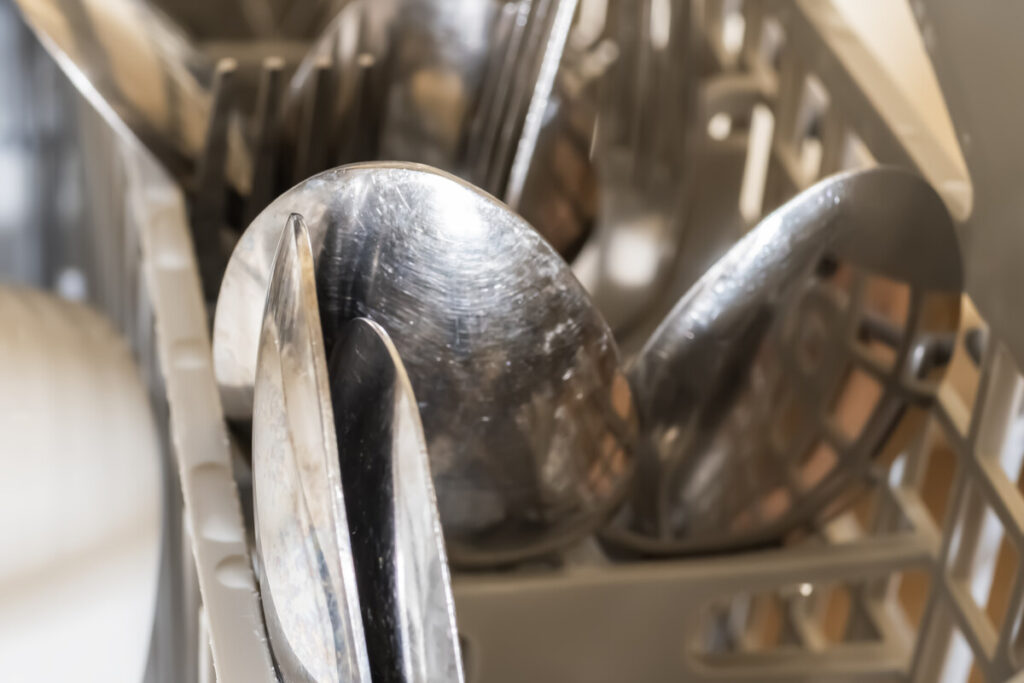
If you have spent any time scrolling short home videos lately, you have probably seen it: someone tosses a crumpled ball of aluminum foil into the silverware basket, runs the dishwasher, and pulls out forks and spoons that look brand new. It is a tempting little trick. Before you tear off a sheet of foil, though, here is what actually happens in a regular family dishwasher, and why I am leaving my foil in the drawer.
What the foil ball hack promises
The idea sounds almost too easy. No special cleaner, no polishing cloth, no elbow grease. You just tuck a loose ball of foil between your knives and spoons, start a normal cycle, and the dull, tarnished look on your flatware is supposed to rinse away. The before and after shots are dramatic, and the hack gets pitched for both stainless steel and real silver.
The explanation people give is a bit of kitchen chemistry. Aluminum is a more reactive metal than silver, so in theory it “sacrifices” itself and pulls the dark, sulfur based tarnish off the silver, leaving the shine behind. That part is not completely made up: a similar reaction is behind some old fashioned silver cleaning baths. The catch is that a dishwasher is not a controlled little bath. It is hot, it sprays hard, and it is full of detergent.
Why it is not worth doing every week
When cleaning testers have actually tried this, the results were all over the place. Sometimes the silverware looked a little brighter, and sometimes there was no visible difference at all. How well it works depends on how hot your water gets, what is in your detergent, and how tarnished the pieces were to begin with. That is a lot of variables for a trick that is supposed to be foolproof.
There is a bigger problem, too. A lot of silver and silver plated pieces simply do not like the dishwasher. High heat, strong water jets and harsh detergent can dull the finish and slowly wear down the plating, wash after wash. Many flatware makers flat out tell you to keep silver plate out of the machine. So even if the foil gives you a quick shine, you may be shortening the life of the very pieces you are trying to rescue.
And then there is the foil itself. Little bits can flake off during the cycle, especially if you use a big wad of it or run several aluminum items in the same load. Those fragments can end up in the filter or get in the way of the spray arms, which is the last thing you want to deal with on a busy weeknight.
Figure out what is really making your flatware dull
Before reaching for any miracle fix, take a closer look at what you are dealing with. Not all dullness is the same thing:
- A cloudy, chalky film usually comes from hard water minerals or detergent buildup, not tarnish.
- Tiny dark pits or spots on stainless are often small areas of corrosion, and unfortunately those do not polish away.
- A yellow, brown or black haze on real silver is true tarnish, caused by sulfur in the air and in some foods.
What to do instead
For real silver, a dedicated silver cleaner used by hand gives you much more consistent results than the foil trick. If you love the chemistry angle, the classic baking soda and aluminum foil bath does work on solid sterling silver, but skip it for silver plated pieces, since it can be too rough on the thin plated layer.
For your everyday stainless forks and spoons, the boring answer is the right one. Use a good rinse aid, check that your dishwasher settings (and water softener, if your machine has one) suit the water in your area, and give the worst pieces a quick hand polish now and then. Keep the special pieces, like Grandma’s silver or anything plated, out of the dishwasher entirely and wash them by hand with warm soapy water, then dry them right away.
Around here, the dishwasher already has enough on its plate. I would rather it just get the dishes clean and leave the silver polishing to a soft cloth and five quiet minutes at the counter.