The best compliment a fake Christmas tree can get is a guest who walks over, pinches a branch and still isn’t sure. If they just smile politely from the couch, something gave it away: flat needles, one single shade of green, or a pole peeking out between the layers.
Artificial trees have come a long way, and some of what matters is printed on the box while some only shows once the tree is standing in your living room. Around here, the tree goes up early and has to survive a whole season of kids and ornament rearranging, so this is what I check first.
Shop early and shop like it’s furniture
Lots of people who go artificial buy in November, well before cut trees show up in parking lots. An artificial tree is something you’ll live with for years, so pick it the way you’d pick a sofa: calmly, with a tape measure in your pocket. And what most of us want is a tree that looks like it came from a tree farm, usually a copy of the classic fir with dark, glossy needles.
PE or PVC needles make the biggest difference
- PVC needles are cut from a flat plastic sheet, then curled around a wire. They’re soft, full and budget friendly, but each needle is a flat, slightly shiny strip, so the illusion falls apart up close.
- PE needles (polyethylene) are molded, often from real branches. Each one has shape, a tip and a slight curve, sometimes two tones of green. That’s the “wait, is it real?” look.
The sweet spot is a mix. Molded PE goes on the branch tips, where your eyes and hands land, and PVC fills the inside to add thickness and hide the frame. A well made 7 foot tree might have around 1,500 tips with roughly a third in PE. Many brands list that ratio, and it’s a great clue to how carefully a tree was designed.
Compare tip counts, not just height
At the same height, more tips means a fuller tree you can’t see through, with branches that hold heavier ornaments without drooping. Typical ranges for a standard width tree:
- 5 foot tree: about 800 to 1,000 tips
- 6 foot tree: about 1,500 to 2,600 tips
- 7 foot tree: about 1,800 to 3,500 tips
- 8 foot tree: about 2,400 to 4,700 tips
A slim tree for a small space will naturally have fewer tips without being less full. And the count says nothing about length or material: 2,000 short PVC tips will never look as lifelike as 1,500 mixed PE and PVC tips. Read both numbers together.
Look closely at color and shape
A real tree is never just one green. Fir needles are deep and glossy on top, lighter and almost silvery underneath. A good fake blends several shades on the same branch, sometimes with lighter tips or a slight blue cast. If you love a snowy look, make sure the flocking is permanently bonded rather than sprayed on, or you’ll sweep white dust all season. A light frost on the tips looks far more believable than a thick even coat.
Then check the silhouette. Real branches grow in uneven tiers with a few gaps. A tree where every layer is an exact copy of the one below gives itself away instantly, no matter how full it is.
Setup, storage and care
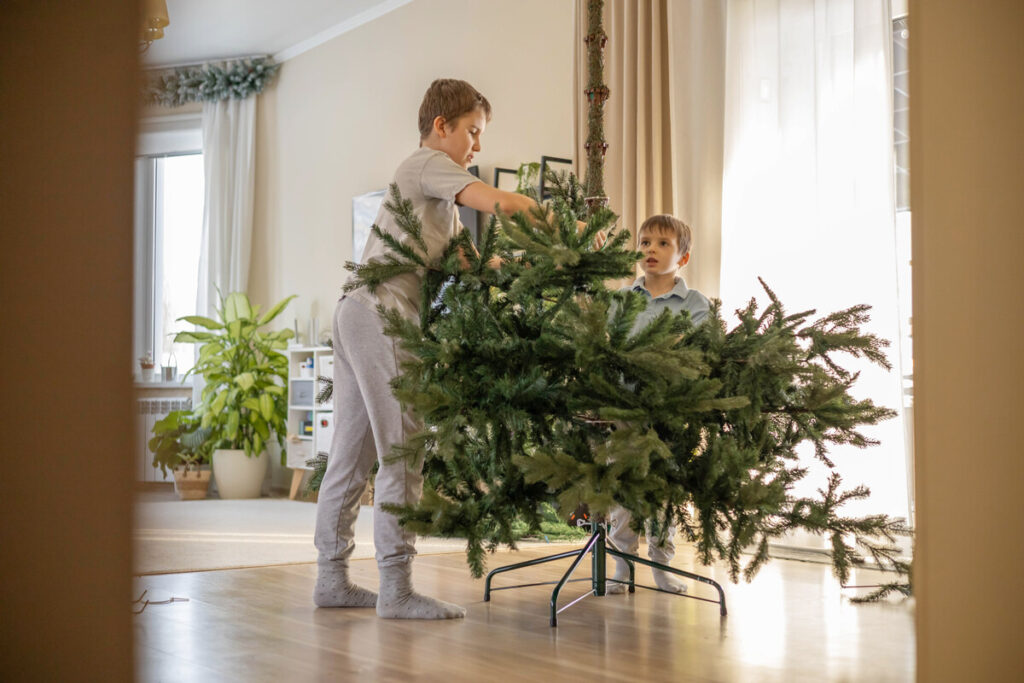
Look for two or three sections that slot onto a center pole, with hinged branches that drop into place. The old color coded branches you push in one by one take an extra hour and age badly. A metal or solid wood stand about 2 feet wide for a 7 foot tree keeps things steady when kids and pets zoom by; light plastic stands always end up leaning.
Don’t rush the fluffing. Spread each tip out like a fan, shorter ones angled up to hide the wire, longer ones pointing out. Before setup, a soft cloth or a hair dryer on cool is all it needs. Store it in a closed bag somewhere dry with a steady temperature, never a damp garage or hot attic.
Since a fake tree has a much bigger footprint to make and ship than a locally grown real one, it only pays off if you keep it a long time. A tree you love pulling out fifteen winters in a row is also the most sensible choice.
Quick answers before you buy
Are pre-lit trees worth it?
Yes, if the LEDs are spread through the depth of each branch and the wiring is tucked along the pole. Warm white gives the softest glow, and look for a UL listing since the tree stays plugged in for weeks.
How can you tell a tree will last?
A metal pole, metal hinges, a sturdy stand and tips that spring back after you bend them.